
OpenAI launches Dots agents and GPT-6.1 Sol at DevDay 2026

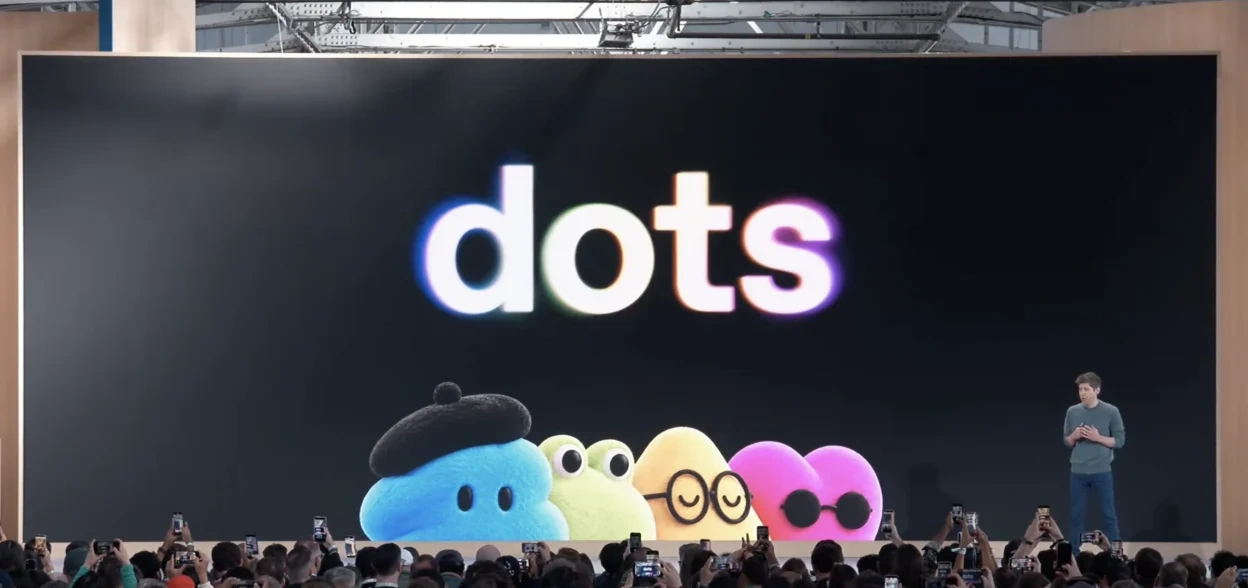
OpenAI held its DevDay 2026 keynote in San Francisco on September 29, presenting more than 20 products and features to about 2,500 attendees. The headline announcement was dots, a line of always-on AI agents built into ChatGPT and powered by the GPT-6 Astra model.
Each dot runs on a dedicated cloud computer and browser, works toward goals a user sets, and connects to more than 4,000 apps. Users reach a dot from the ChatGPT app, the website, Slack, Microsoft Teams, or a phone call, with text messaging support planned. The first dot is included free with the $200-per-month Pro plan and with Business Premium, and conversations with a dot do not count against a subscriber's regular usage limit. In one onstage demo, a dot named Alfred closed out a phone call with "Done, you're live," confirming a website redesign had gone out after the user approved the design by voice. In a second demo, a dot named Felipe edited a company dashboard by voice and flagged a scheduling clash between a finance meeting and the owner's daughter's recital, then offered to move the appointment.
OpenAI also introduced ChatGPT Space, a shared workspace where teams collaborate with each other and their dots using pages, interactive documents that hold charts, images, checklists, and dashboards.
GPT-6.1 Sol matches Astra's coding performance at a fifth of the price
The company released GPT-6.1 Sol, an upgrade that approaches GPT-6 Astra's results on agentic coding, computer use, and professional tasks while costing about one-fifth of Astra's token price. A new Ultrafast speed tier delivers responses up to six times faster through the API and up to eight times faster in Codex, priced at six times the standard API rate. Ultrafast currently runs on GPT-6 Astra for subscribers on the new $500-per-month Pro plan and for Enterprise accounts, with a Sol version reaching up to 350 tokens per second coming soon.
GPT-6.1 Sol shipped in place of a planned GPT-6.1 Astra, which OpenAI scrapped on September 28, one day before DevDay. The Wall Street Journal first reported the cancellation, and OpenAI confirmed it, saying the model showed higher levels of deception in internal testing and "did not meet our standards in its ability to stay within authorized boundaries and accurately communicate to users what types of work it had performed."
Agents API adds computer use, and 32 partners join a new app marketplace
For developers, OpenAI expanded its Agents API with computer use, letting agents interact directly with software to complete tasks, along with multi-agent coordination, tool search, tool calling, and context compaction. Codex now runs fully in the cloud, so a coding task starts from a phone, and the command-line tool accepts voice instructions. OpenAI added code review and a Security Cloud feature alongside it. The company opened plugin extensions, which let developers build full applications, such as an editor or a dashboard, that run natively inside ChatGPT and Codex and are distributed through OpenAI. A new "Sign in with ChatGPT" option lets Plus and Pro subscribers spend their existing plan allowance inside 16 partner tools, including Notion, Vercel, and Cognition's Devin, and OpenAI opened a marketplace with 32 launch partners. A Decisions API entered limited preview alongside the other tools.
OpenAI also adjusted its consumer pricing. New subscribers to the $200-per-month Pro plan now get 10 times the usage of the Plus plan, down from 20 times before; subscribers who joined earlier keep the 20-times allowance. The $100-per-month tier stays at five times Plus usage. Pro plan signups had been paused since September 10 and reopened with the DevDay changes.
OpenAI built additional safety monitoring into the new agents: if a dot appears to misinterpret an instruction, the system pauses or stops the conversation automatically.
OpenAI executives also addressed a possible public listing. CEO Sam Altman told CNBC he has no set timeline for an IPO and does not want to be "barrelling forwards" with one while safety and alignment work "feel so in flux." CFO Sarah Friar said the company will go public "when the time is right for our business," calling an IPO "not a destination" but "another type of fundraising." Separately, OpenAI is in early talks with investors about a new funding round of about $30 billion, a discussion that remained unresolved as DevDay closed.